Formula One Miami: which driver profile the Miami International Autodrome…
The Miami International Autodrome is a demanding hybrid: a modern, semi‑street 5.41 km circuit with 19 corners that pairs long, high‑speed straights with sinuous technical sections and tight turns. That unique balance reshapes what a driver must be to prosper across a Miami weekend — not just single‑lap speed but measurable precision, bold braking, and adaptive race management.
Quick summary: Miami rewards drivers who blend precise steering and braking with attacking confidence in heavy‑braking zones, while adapting setup and pace to a layout that forces a compromise between low drag for the long straights and downforce for the twisty mid‑sector.
Quick links:
First technical reading•Braking, release & corner entry•Exit traction & tyre management•Racecraft & overtaking•Closing interpretation
FIRST TECHNICAL READING OF THE DRIVER
From a technical perspective, the first clues a Miami weekend gives you are about compromise and discipline. The track's 5.41 km layout combines long straights — where top speed is decisive — with a sinuous mid‑sector (notably Turns 13–16) and several tight corners. A driver who reads Miami well shows both an ability to extract maximum speed down the straights when the car is set low drag, and to negotiate rapid direction changes where downforce and precise line control matter.
BRAKING, RELEASE, AND CORNER ENTRY
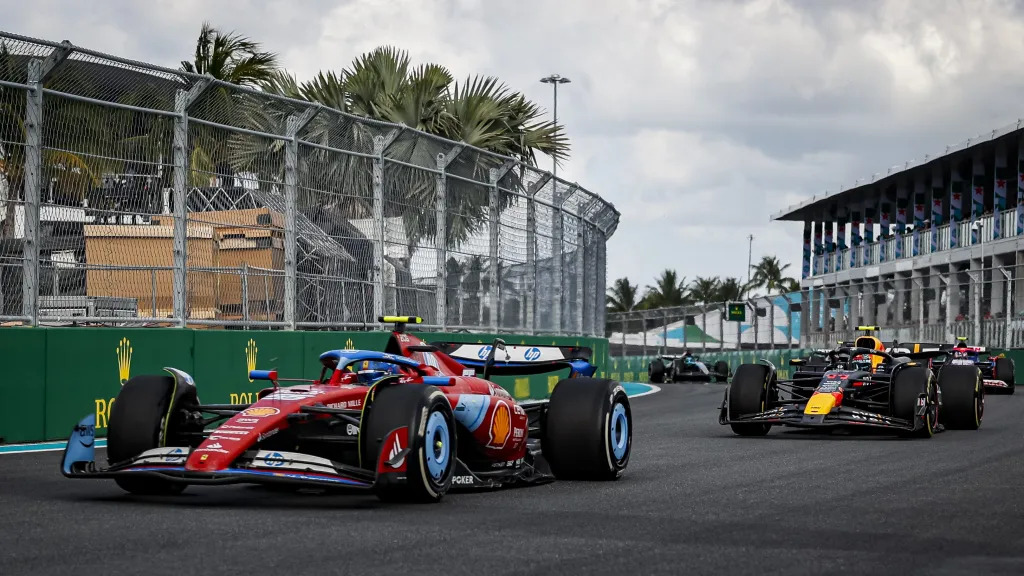
Overtaking and lap time at Miami concentrate around heavy braking zones at the end of long straights. Drivers who can consistently carry confident, late braking into these zones win places, but the circuit also punishes imprecision: large kerbs and narrow sections can unsettle the car and remove any marginal advantage gained from aggressive kerb use. That creates a premium for disciplined brake release and measured rotation — a braking style that is committed but controlled, sacrificing tiny entry aggression if it avoids destabilising the car on the exit.
MID-CORNER SHAPE AND MINIMUM SPEED
The sinuous mid‑sector rewards drivers who can manage minimum speed without over‑risking the front end. Because teams run a compromise setup between low drag and downforce, drivers often protect a lap by choosing stable mid‑corner lines rather than chasing lower apex speeds that expose the car to snap understeer or oversteer. In practice this means a patient mid‑corner shape that preserves traction and keeps the lap repeatable across multiple corners in sequence.

EXIT TRACTION AND TYRE MANAGEMENT
Miami puts a clear strain on tyre life because of the mix of high‑speed runs and tight direction changes. Drivers who can apply drive progressively on exit and avoid aggressive wheelspin protect tyre fronts and rears across a stint. Given the layout's compromise setup, overly aggressive traction application that heats and flakes tyres early tends to cost more over a race distance than it gains over one lap, so tyre saving—particularly on the exits that follow tight corners—is an important trait for success.
QUALIFYING PROFILE AND ONE-LAP RISK
Qualifying matters at Miami because overtaking is concentrated to a few heavy‑braking zones and the final sector. A driver's one‑lap approach must therefore combine low‑drag straightline speed with flawless performance through the mid‑sector. That typically favours drivers who can push the envelope without destabilising the car on kerbs or in the twisty sequences; one‑lap bravery is valuable, but it must be balanced against the risk of upsetting the car where kerbs and narrow lines can punish an aggressive attempt.
RACECRAFT, OVERTAKING, AND DEFENSIVE IQ
Because most passes happen in a handful of zones, racecraft at Miami is about timing and precision. Successful overtakes frequently combine late, committed braking with a solid exit over the following corner sequence. Drivers who read the track evolution and the opponent's weaknesses in those decisive zones will convert more moves. Defensively, choosing lines that protect the braking zones while avoiding kerb contact that could invite a mistake is a nuanced task—so situational judgment and positional discipline are as important as raw wheel‑to‑wheel aggression.
ADAPTATION TO THE TRACK AND SURFACE
Surface grip evolved at Miami after early editions, when paddock voices noted low off‑line grip and surface issues. Subsequent tweaks improved racing lines and overtaking opportunities. A driver who adapts quickly across a weekend to changing grip levels and to the setup compromise required by the circuit gains an advantage: faster learning of usable off‑line passages, better tyre conservation strategies, and smarter adjustments to braking and steering inputs as the surface changes.
CLOSING INTERPRETATION
In short, the Miami International Autodrome favours a modern, multifaceted driver profile: precise with steering and braking, confident attacking into heavy‑braking zones, and measured enough on exits to protect tyres and keep a repeatable rhythm. Success requires an ability to read a weekend, refine setup toward a compromise between low drag and downforce, and adapt driving inputs as grip and kerb behaviour evolve. That combination—precision under pressure, calibrated aggression, and adaptive race management—is the clearest filter Miami applies to a driver's true strengths.
Author: Cynthia D.