F1 slipstream explained: how drafting, dirty air and DRS differ
Slipstreaming — also called drafting or tow — is a simple aerodynamic trick with big tactical value in Formula 1. This article explains what slipstream is, how drivers use the wake of a car ahead to gain straight-line speed on straights, and why it is different from both dirty air and DRS. Readers will get both a beginner-friendly definition and the practical, race-focused detail fans need to read a Grand Prix.
Quick summary: Slipstream is a passive reduction in aerodynamic drag for a trailing car that follows in the wake of a lead car. It helps on long straights when a driver tucks in behind another car, before peeling out to attempt an overtake. Dirty air is the turbulent wake that harms following grip through corners. DRS is a mechanical flap that actively reduces rear-wing drag under FIA conditions and is distinct from slipstreaming.
Clear definition
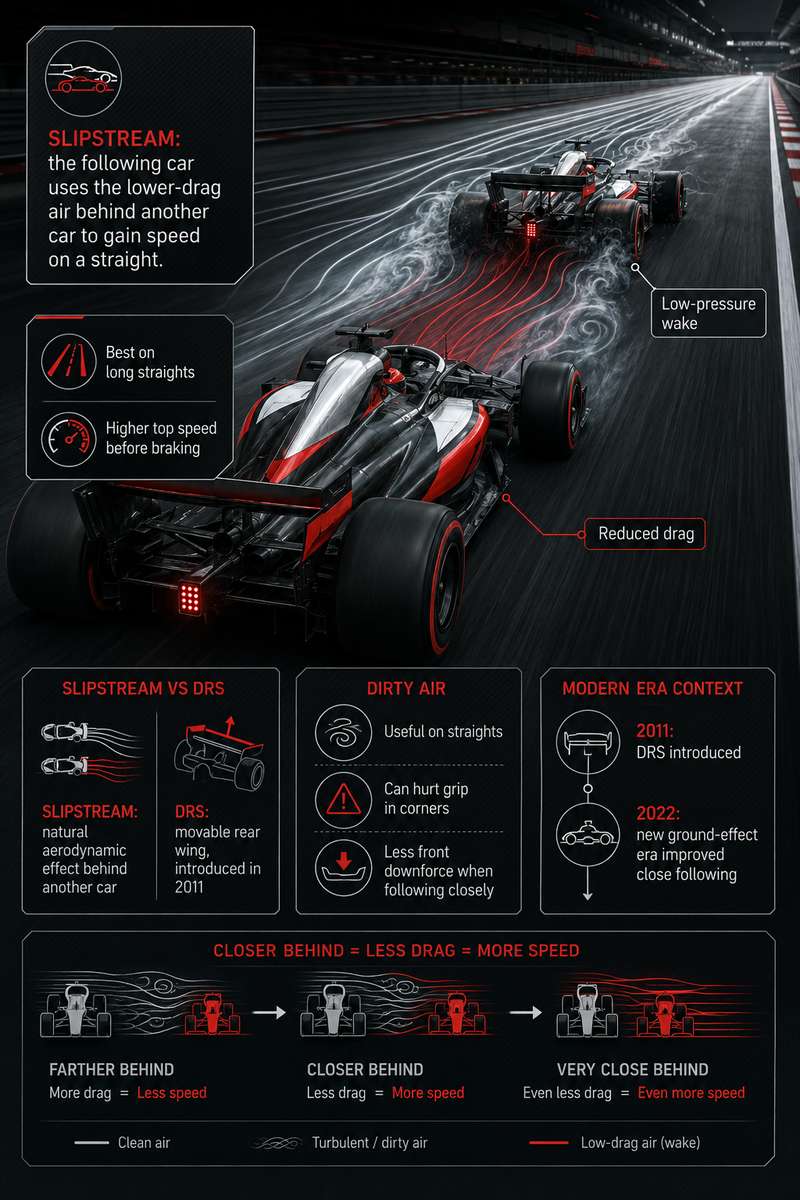
Slipstreaming in Formula 1 is the effect that occurs when a car follows closely behind another and enters its aerodynamic wake. In that wake the airflow moves with the cars, reducing aerodynamic drag on the trailing car. With lower drag the trailing car can achieve higher straight-line speed for the same engine output — a practical gain known in racing as drafting or tow.
How it works in F1 terms
The physics are straightforward: a moving car displaces air and creates a region behind it where the airflow is disturbed and partially carried forward by the lead vehicle. A following car placed in that region encounters less opposing air resistance on its body and wings, so the power unit needs to overcome less drag. In Formula 1 this translates into measurable extra top speed on long straights when a driver tucks in directly behind another car.
Drivers typically position the nose of their car close behind the lead car on the straight, use the reduced drag to accelerate more quickly, then pull out of the wake to sweep past when the speed advantage is largest.
DRS vs slipstream: complementary but different
DRS (Drag Reduction System) is an active aerodynamic device — a movable flap on the rear wing that reduces drag when opened. Its activation is controlled under FIA rules and limited to designated DRS zones and conditions. Slipstreaming is passive: it comes from the airflow pattern created by the car ahead rather than any movable part on the trailing car.
Both can increase straight-line speed. They are complementary: a chasing car can benefit simultaneously from the reduced wake drag while also opening its DRS where regulations permit, producing a larger combined speed gain than either effect alone. However, unlike slipstreaming, DRS is applied by the trailing car itself and is subject to activation rules.
Dirty air explained and why it matters
Dirty air is the turbulent, disturbed wake left behind a race car that reduces aerodynamic downforce for a following car. While slipstream focuses on reduced drag in a straight-line wake, dirty air highlights the negative consequence of that disturbed airflow for cornering: when a car follows closely through turns it can lose downforce and mechanical grip, making it harder to maintain pace and tyre temperatures.
In short, slipstream helps on straights by lowering drag; dirty air hinders through corners by reducing downforce. Both are two sides of the same aerodynamic interaction between cars.
Strategy and racecraft implications
Slipstreaming is a simple tactical tool with several strategic uses. On high-speed circuits with long straights, drivers will follow into the wake to close gaps before an overtaking attempt. Teams plan race approach knowing that slipstream can make overtakes easier at specific parts of the lap, and qualifying lines or tow swaps can also be arranged in some sessions to produce mutual benefit.
Because slipstream gives a temporary speed advantage without changing tyre wear directly, it is often used to set up a pass before a braking zone. But drivers must balance the straight-line gain against the risk of encountering dirty air through the next corner, which can cost grip and ruin the move if the chased car defends effectively.
Car behaviour and technical context
Modern F1 aerodynamics determine both how strong a slipstream feels and how harmful dirty air is. Regulatory changes aimed at altering wake behaviour — for example the introduction of ground-effect-focused designs in recent rule cycles — have changed the magnitude and character of wakes, so the net effect of slipstream and dirty air evolves with the cars' aero philosophy.
From a setup perspective, teams consider how a car handles in clean air versus in another car’s wake. Drafting reduces drag but being in turbulent air lowers downforce; engineers and drivers must therefore accept trade-offs depending on the circuit layout and strategic plan.
Common misunderstandings
Beginners often conflate slipstream, dirty air and DRS. Remember these clear distinctions: slipstream is a passive drag reduction for the trailing car’s straight-line speed; dirty air is the disturbed wake that reduces downforce for the follower through corners; DRS is an active, regulated flap on the pursuing car that cuts its rear-wing drag in specified zones.
Another frequent mistake is assuming slipstream always helps: it benefits top speed on straights but can leave the chasing driver disadvantaged immediately afterwards because of reduced cornering grip from dirty air.
Closing interpretation
Slipstreaming is one of the purest examples of how aerodynamics shapes racing. It is a passive, situational advantage that drivers and teams use to create overtaking opportunities, while dirty air and DRS sit on the same aerodynamic spectrum but behave very differently. Understanding slipstream — when it helps, when it hurts, and how it interacts with DRS and car design — makes it easier to read why overtakes happen at specific points on a lap and why following another car is a nuanced skill in modern Formula 1.
Author: Eric M.